


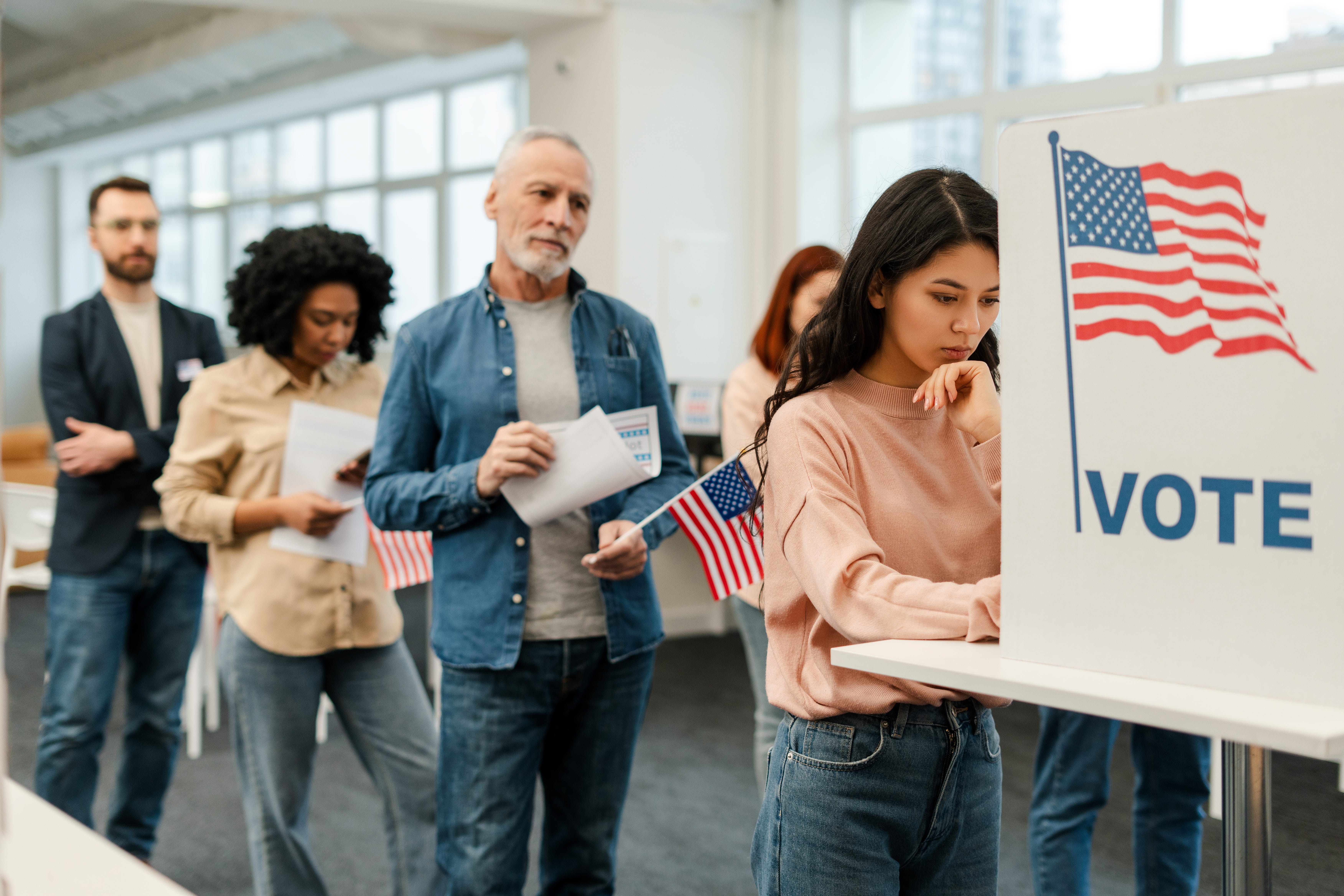
We’re getting closer to Election Day in the United States, which means many people are about to look for answers to one question: where do I actually vote? In the past, that meant searching online for the answer. Now, people still search, but instead of a list of links, they get an AI-generated overview that confidently tells them where to go. This piece is about what goes into the chatbot giving you an answer.
This is one of those things that looks simple and is actually pretty complicated. I’ve wanted to write about this process for years as I’ve watched this problem from a few different angles: building election tools at Facebook, sitting on Democracy Works’ board since 2018, and this year, doing two election-and-AI roundtables with the companies, election officials, and researchers trying to work through it together.
Here’s what makes it complicated.
First, there are over 10,000 election jurisdictions across the country, tens of thousands of voting locations, and numerous state-specific deadlines to track.
Second, this decentralization challenges companies like Google, which need not only all the information in one place, but also a way to retrieve it easily.
Third, this information can change up to and on Election Day. Power could go out at a precinct, forcing a location change; a court order could keep a polling place open longer; and every state has its own election laws.
There’s a lot more to why this is complicated, but you get the drift. The good news is that for over ten years, dedicated groups have worked to make sure this information gets to you. They’re often unsung heroes because no one notices if the answer is right, and I want to celebrate them by highlighting their work.
For years, the fix has been the Voting Information Project, a partnership going back to 2008 between Pew, Google, and state and local election officials. Democracy Works has run it since 2018, working with more than 40 states plus DC. Election officials provide and verify the data; researchers fill the gaps from official websites, legislation, and direct calls to election offices, with two rounds of quality checks.
Then, when people searched for this information, companies like Google and Facebook could pull from that database to show people where to vote or remind them it’s Election Day.
In the next few weeks, if you find yourself looking for information about how to vote on Election Day, remember the years of work that went into making sure you can get that information in a second.
None of this is cheap either, and little of it is obvious from the outside. Tech companies pay for access to this infrastructure, and philanthropy covers much of the rest. But sustaining the pipeline requires year-round work — researchers verifying data, officials fielding calls, systems getting updated — even though donors tend to show up at the last minute rather than funding the off-years and the months beforehand. Organizations like Democracy Works end up scrambling for funding in the weeks before Election Day, even though the real work never stopped. Because it looks so simple from the outside, it’s easy to underfund — and it’s under threat every single cycle.
Things have gotten more complicated in the AI era. People aren’t just doing search queries; they’re doing multi-turn prompts or conversations with AI about not only where to vote, but who is on the ballot, what documentation you might need to vote, and where the candidates stand on the issues. Early information from Democracy Works shows a growing number of people turning to chatbots for this information on everything from early voting and mail-in voting to whether they are registered.
This means AI models—including ChatGPT and Claude, among others—have to be trained to respond to those prompts and know where to pull the information from. That changes depending on what you are prompting.
A few recent studies have not had good news on this front, including the Institute for Strategic Dialogue, which tested six models across 10 states in June 2026. 29% of English answers were incomplete, inaccurate, or outdated, and 12% could meaningfully mislead a voter. Spanish-language accuracy was 16 points lower.
Fortunately, companies have spent the past year refining their systems and partnering with Democracy Works to address these issues, though those integrations weren’t active when the studies were conducted. These partnerships can take a few different forms, including:
Some platforms can answer voter questions directly using Democracy Works’ data, without ever sending a voter elsewhere.
Other platforms use Democracy Works’ data to point voters to a trusted, accurate destination for answers, like TurboVote.
Hybrid platforms combine both approaches, pulling dates and deadlines through the Democracy Works API while redirecting voters to a trusted page for next steps.
Alongside VIP, organizations like the National Association of Secretaries of State (NASS) and the National Association of State Election Directors (NASED) run their own pipeline connecting companies like Microsoft directly with election officials.
Here’s how each company describes their approach for 2026:
Anthropic: Shows a banner sending U.S. users to Democracy Works’ TurboVote, and leans on web search for freshness. Its own testing found Claude triggered search on 92–95% of midterm questions. (Anthropic posted an update about their 2026 election efforts on October 14, including that conversations that touch broadly on politics, public policy, or social issues account for about 5.75% of all conversations in the United States on Claude.ai.)
Google: Draws on state and local governments and Democracy Works for logistics, and the AP for results. In 2022, those “how to vote” and “where to vote” features were seen more than 140 million times.
Meta: Lets officials push Voting Alerts directly to Facebook users. Meta says officials have sent more than 1 billion of them. They also run Election Day reminders to connect people with local and state voting information
Microsoft: Is running a “Check. Recheck. Vote.“ campaign with NASS and NASED that pushes people back to state and local sites.
OpenAI: Displays Democracy Works data for registration and voting logistics in ChatGPT, uses the AP for live counts, and relies on web search for everything else.
Reddit: Partnered with National Voter Registration Day and Vote Early Day to help ensure that Reddit users of all views and persuasions have ample resources to learn about voter registration and the different options they have to cast a ballot. They’re also hosting an election AMA series, where nonpartisan experts explained voting processes and answered questions about how elections work.
Annoyingly for anyone trying to track it, this work is ongoing, which means that a lot has changed in the last few days, let alone the last few months. The good news is that, in general, these changes have improved the answers for voters - especially on where, when and how to vote.
Other answers, such as candidates’ positions on issues or who someone should vote for, are a lot more complicated. That is a post for another day, but I recommend following Forum AI and Andy Hall with Free Systems (who recently joined Anthropic), who have excellent Substack newsletters outlining the challenges platforms face in knowing which sources to pull from when answering these questions.
Where this all goes in the future is unknown.
There’s a common assumption that AI will eventually scour every election website and solve this. That’s aspirational. We’re not there for these midterms, and my guess is we won’t be there for 2028 either, because people will be, rightfully, nervous about handing this entirely over to a model.
And that’s before you get to agents. Most election websites are barely mobile-friendly, let alone built for an agent to crawl and parse on someone’s behalf. That will be a big problem to solve for 2028 as well.
So, what should you as a voter know when going online to find this information?
First, before anything else: election officials are the authoritative source. They legally oversee your polling place, your ballot, and your deadlines. Everything I describe exists downstream of them, not instead of them. When in doubt, go directly to their site for information.
Second, it’s okay that you don’t know their name or the URL of the website you should go to. You can still use your favorite search engine or chatbot. I’m not telling you not to. Instead, just, as Microsoft says, check and recheck the information it’s giving you.
In the next few weeks, if you find yourself looking for information about how to vote on Election Day, remember the years of work that went into making sure you can get that information in a second. If you work with funders, encourage them to support this work. No one notices if the answer is right, and that’s the point. And finally, don’t forget to thank the election workers who dedicate a lot of their time to make it as easy as possible for you to participate and ensure your vote is counted.
PS: Make sure to check out two new pieces from my friends at the Center for Democracy and Technology:
Anticipating Election Misinformation in the 2026 Midterms: Some of the false and misleading claims that voters are likely to see in the midterms.
Political Campaign Use of AI-Powered Voter Outreach Highlights Regulatory Gaps: This piece examines what the federal Telephone Consumer Protection Act (TCPA) actually requires for AI-powered political texting, highlights gaps left by unclear and unfinished FCC action, surveys the emerging patchwork of state disclosure laws, and considers the constitutionality and privacy questions inherent in regulating this new technology.
thanks for writing. the good news is that more access to voting information is healthy for the country. we're in this mess because the Parties have pissed people off so much they are apathetic in the good times, or furious in the bad times. both states of mind are not great when it comes to being civically engaged. the very fact that more people are searching for polling locations, who is on the ballot, hopefully researching propositions etc is a good sign. there are so many things to vote in state and local elections and if the number of people seeking out the answers goes up, then culture is getting more healthy. of course the biggest worry is that the tool used to research can be manipulated and used for propaganda. that's why we need very strong guardrails around AI and cannot trust the tech bros to do the right thing. they will only try and bring us together as long as it makes them the most money (and while they make money from driving us apart on social media).