

The Transparency Paradox: Voters Want Disclosure, Then Punish the People Who Give It
Voters aren't telling campaigns to stop using AI or not to work with influencers. They're telling campaigns not to use it to fool them.

Two things struck me while I was looking at both of our poll numbers from May and July. Voters say they want to know when campaigns are using AI or talking to influencers. But on the flip side, a lot of voters find most of what campaigns could actually use AI for unacceptable. And in the influencer case, finding out someone is being paid causes voters to trust that person less.
In May, 78% of voters said it’s important that campaigns clearly disclose when content is created using AI. Fifty-seven percent said very important. That number holds across the political line: 60% of Trump voters and 61% of Harris voters called it very important.
Then in July, we asked the question: When a creator discloses that a political post was paid for by a campaign, what happens to your trust in them? Forty-seven percent said they trust that creator less. Eleven percent said more.
Voters are asking for disclosure and then charging for it. That’s the transparency paradox, and it’s going to shape how campaigns handle both AI and influencers for the rest of this cycle and as we head into the next presidential election.
The paradox campaigns are actually facing
Here’s the part that makes this hard, not just uncomfortable. Voters want disclosure, but for most of what disclosure would reveal, they find the underlying use unacceptable in the first place:
Analyzing voter data: 43% acceptable, 41% unacceptable
Writing speeches or emails: 37% acceptable, 49% unacceptable
Generating images or videos: 33% acceptable, 53% unacceptable
Engaging voters through chatbots: 30% acceptable, 55% unacceptable
Targeting voters with personalized messages: 26% acceptable, 58% unacceptable
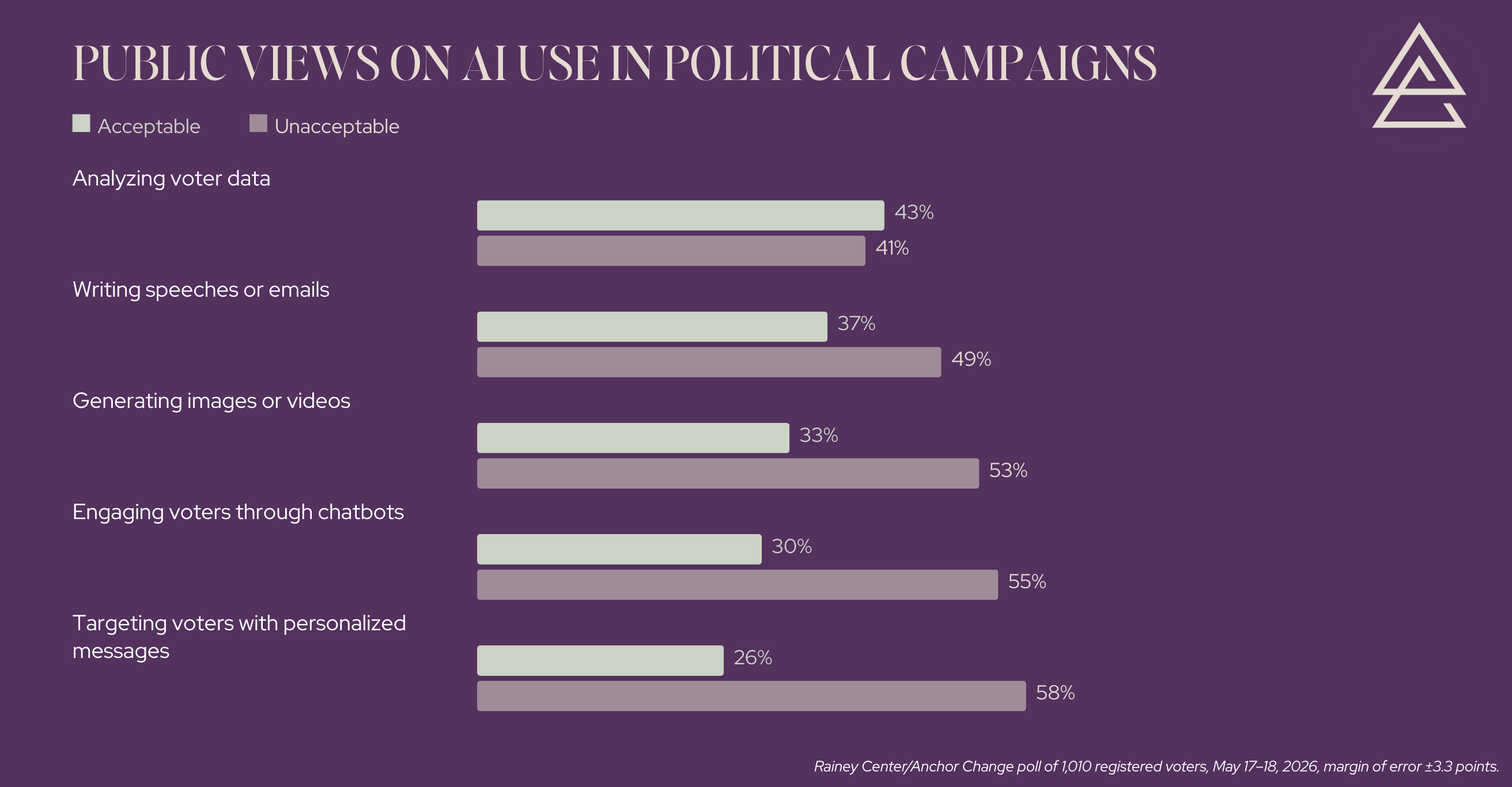
Voter data analysis is the only one where acceptance comes close to matching objection, and even that’s a wash rather than a win. Every other use is net negative, and personalized targeting is the worst of the group, at a 32-point net negative. Targeting runs on the data analysis voters are the most fine with. They’re objecting to the output of a process they largely accept.
So this is the actual paradox for campaigns, not just the disclosure one. Voters want to know when AI is being used, and once they know, they mostly don’t like what it was used for. A campaign that’s honest about its AI use is handing voters a reason to be annoyed with it. A campaign that stays quiet risks the bigger story later. Meanwhile, every other campaign is using these tools whether voters like it or not, because the tools work, and nobody wants to be the one operation that unilaterally disarms. That’s the bind: disclose and take the hit, stay quiet and take a bigger one if you’re caught, or opt out entirely and lose the edge every other campaign is already using.
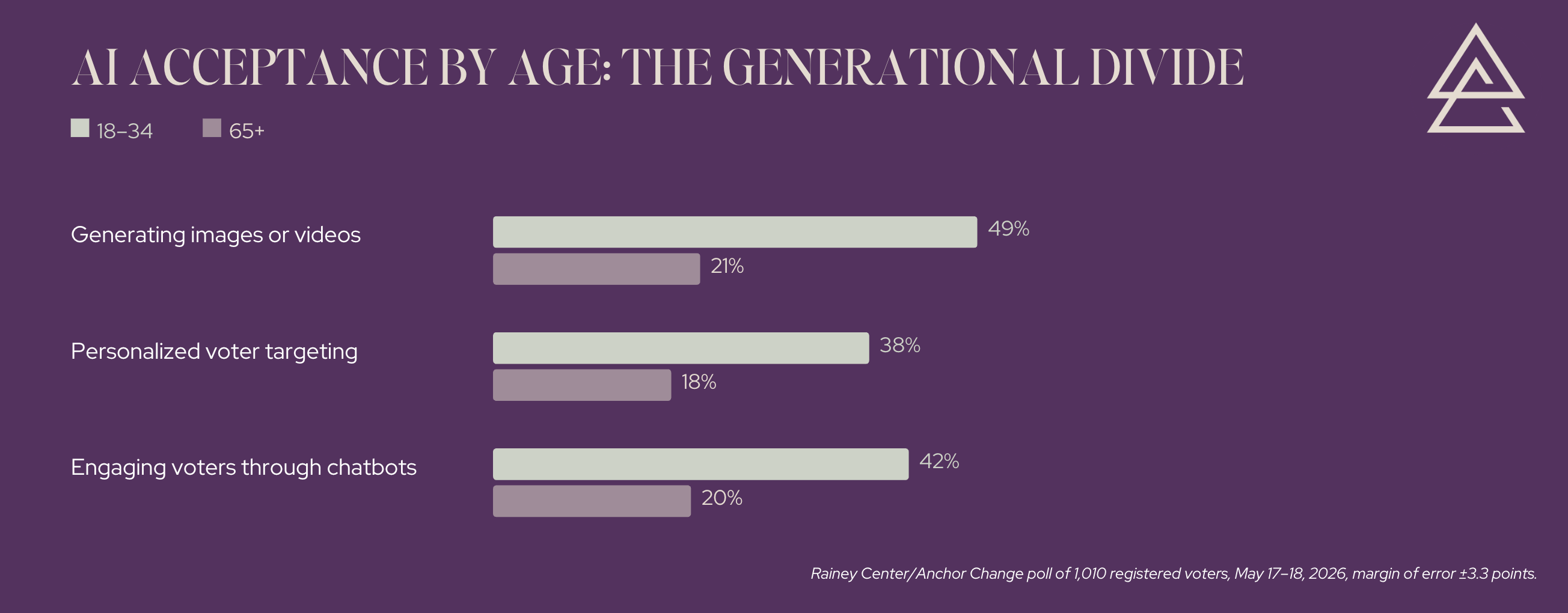
The age breakdown is where this gets more interesting. Acceptance of AI-generated images and video is 49% among voters 18–34, against 34% who call it unacceptable. That’s a net positive. Among voters 65+, it’s 21% acceptable to 69% unacceptable. Same question, same content, close to a 50-point swing in the reaction depending on who’s answering. The pattern holds across every category: personalized targeting is 38% acceptable among 18–34-year-olds versus 18% among 65+, chatbot engagement is 42% versus 20%. Younger voters aren’t uniformly fine with AI in politics, but the ceiling on what they’ll tolerate is dramatically higher than it is for older voters, and a campaign building a youth program around AI-native tools is working with a very different electorate than one running a traditional direct-mail operation to seniors.
Ask voters generally what worries them most about AI in politics, and the answer isn’t the technology itself. It’s 62% saying false or misleading content: deepfakes, misinformation. Lack of transparency comes in at 22%.
Voters aren’t telling campaigns to stop using AI or not to work with influencers. They’re telling campaigns not to use it to fool them. It’s just that “not fooling them” and “doing the things they say are unacceptable” turn out to overlap more than campaigns are going to want to admit.
What disclosure costs
The influencer numbers are where this really starts having a price.
We asked whether campaigns should be allowed to pay influencers and creators to promote candidates, as long as the payments are disclosed. Forty-eight percent said no. Eighteen percent said yes. Another 17% said only for some types of content.
Disclosure doesn’t buy permission. Nearly half of voters object to the practice even in its most transparent form. And separately, disclosing costs the creator trust: 47% say they trust the creator less once they know, against 11% who trust them more.
The real driver here isn’t the money itself. It’s what the money makes people wonder. If someone you follow because you trust their take suddenly tells you a campaign paid them, the question isn’t “how much did they get.” It’s “was any of this ever real, or was I listening to an ad the whole time.” That’s a much harder thing to earn back than a one-time trust hit. It calls into question everything the creator said before the disclosure, not just the sponsored post itself.
Which is why I think the fix isn’t better disclosure language. It’s a different structure entirely. If a campaign came to me and wanted access to my audience, I wouldn’t take the money quietly and hope a disclaimer covers it. I’d tell my readers directly: this campaign paid for this, here’s what we’re doing, here’s why I think it’s worth your time anyway. Set up as its own thing — a labeled, sponsored conversation, not a normal post with a disclaimer buried in it. Voters get that money exists in politics and they want to know when they’re inside a transaction. Give them that context up front, and it’s possible you’ve removed the thing that actually erodes trust: finding out after the fact.
One more number to note as well. We asked who should be primarily responsible for making sure voters know political content is paid for. Twenty-nine percent said the campaign. Twenty percent said the government, 16% the influencer, 14% the platform. Voters are putting this on campaigns, not on platforms or regulators — which means the obligation lands with the people who have the strongest incentive to avoid it.
Where the two paths actually lead
I expect a lot of campaigns to quietly choose silence over disclosure this cycle. Stay quiet, and you avoid the hit until someone finds out, at which point you’ve handed your opponent a story and confirmed every suspicion a voter already had about you. I understand the math that gets campaigns there, and I think it’s the wrong call.
On AI, the trust penalty is likely temporary. Voters are going to get used to AI in campaigns the way they got used to it in customer service and email. In a couple of years, a disclosure line on an AI-assisted ad will read like a paid-for-by line: standard, unremarkable, ignored. Campaigns that build the habit now get to set what normal disclosure looks like, instead of having it defined for them later by whichever campaign gets caught first.
On influencers, I’m not convinced the paid post ever really works. You can pay a creator, but what you’re buying is a post from someone whose audience just learned they were paid. Nearly half of voters say campaigns shouldn’t be allowed to do that at all. The return on the spend looks small next to what it costs the creator, whose entire value to you was the trust you’re now spending down.
The better version of this is slower, and mostly free. Show up in creator spaces without a transaction attached. Go on a podcast and talk about who you are, not the sound bite. Build the relationship over months so that when a creator eventually talks about you, it’s because they wanted to, not because you paid for it.
Hillary Clinton got at a piece of this recently, co-hosting an episode of Pivot with Kara Swisher that touched on the Michigan Senate race. She said that many voters are, “looking for a candidate, regardless of almost where that candidate might stand or their positioning, but who, first and foremost, they can relate to through the screen.” That’s the same instinct. Authenticity reads as more trustworthy than a managed message, and voters can tell the difference.
There’s a real infrastructure problem sitting under all of this, and I don’t want to wave past it. Independent journalists and creators covering campaigns often can’t afford to be there — travel, credentials, time. Telling them to work for free isn’t a transparency policy. It’s a filter that leaves only the people who can already afford access.
One idea I’ve been thinking about to solve this is perhaps a party committee or outside organization sets up a coverage fund that independent journalists and creators can apply to, with published criteria and no editorial input from the campaign. The campaign isn’t paying the creator directly. It’s funding their ability to be there. That’s a different relationship than a sponsored post, and I think it survives disclosure in a way a direct payment doesn’t.
The midterms are going to be a real test of all this. The presidential race is when it gets turbocharged — more money, more scrutiny, and voters who’ve had two more years to notice who was straight with them.
If this helped you connect some dots, consider sharing it with someone else trying to make sense of where AI, technology, politics, and public trust are all heading next. Word of mouth is still how most people find me, and I’m grateful for every share.