

What Campaign Professionals Told Us About AI in Politics
The tools are splitting by party, the governance is lagging, and voters want more transparency than campaigns are giving them.

Reading time: ~8 minutes
On June 11th at 1 pm ET, I'm hosting a live briefing on AI and the 2026 midterms — pulling from our Rainey Center poll of 1,010 likely voters and our survey of 68 campaign professionals. It's also a live preview of what my monthly Briefing Network calls look like. Space is limited.
Last week, I showed you that voters are turning to AI to fact-check political claims and that the tools are getting it wrong nearly 90% of the time. This week, we’re releasing the results of our survey of campaign professionals to find out what they’re actually doing with AI behind the scenes. (A huge thank you to everyone who filled out the survey!) What I found most interesting is how campaigns are most worried about AI responses, which makes sense given what I wrote about last week, but they also aren’t disclosing their use as much as voters would like them to. You can explore the full survey data in our interactive dashboard.
📊 What campaigns are actually doing with AI
Let’s start here: 87% of campaign professionals are using AI daily or several times a week — 63% daily, another 24% several times a week. Seventy-four percent believe it will be essential to staying competitive in the next 1–2 election cycles.
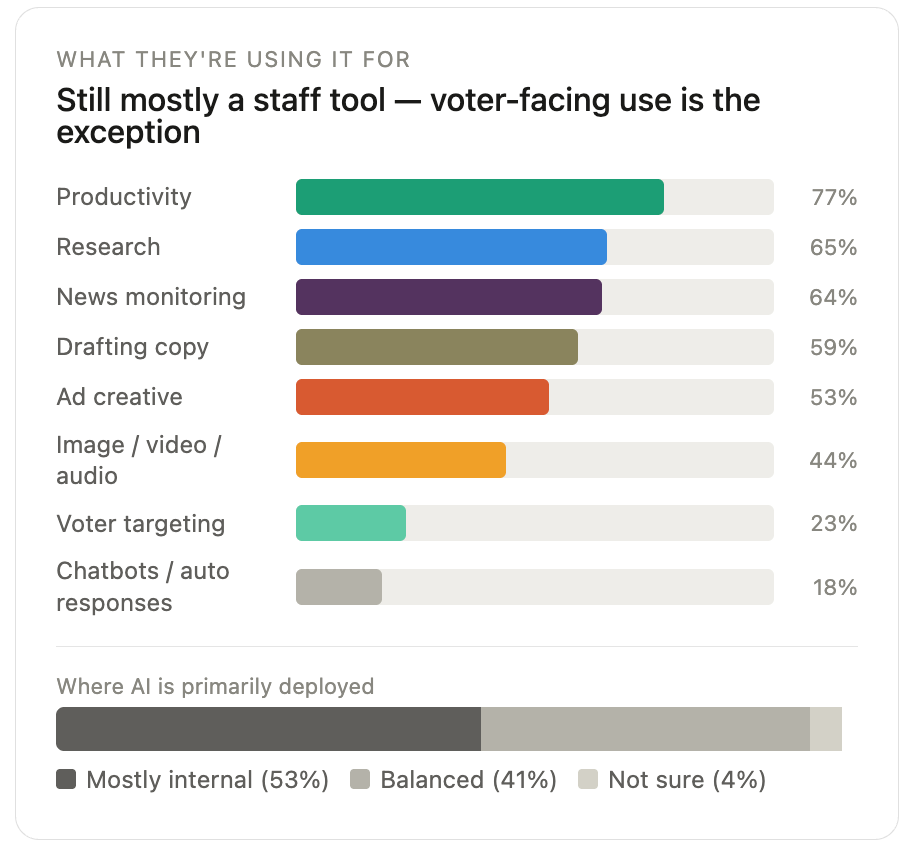
The use cases skew heavily internal. Research (65%), news monitoring (64%), and drafting (59%) are among the top three — AI helping campaigns synthesize faster, brief staff earlier, and draft at a pace that wasn’t previously possible. Only 22% are using it for voter targeting, and 18% for chatbots or automated voter responses. For now, the biggest gains are happening backstage.
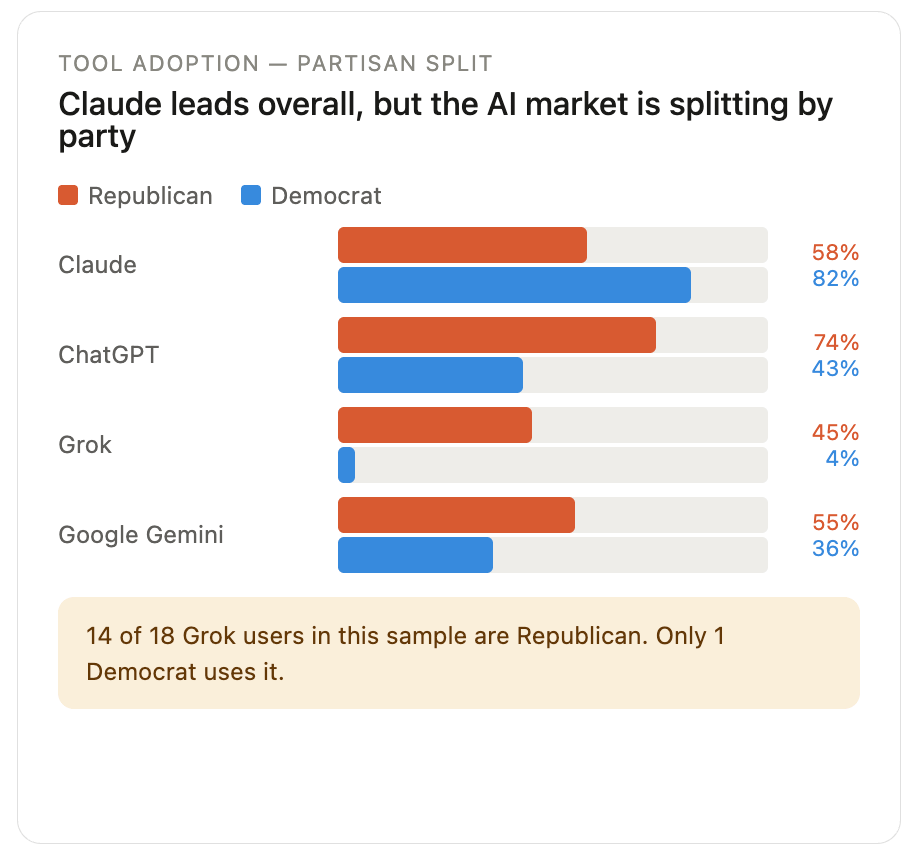
The tool market is also splitting along party lines. Claude is the dominant choice among Democrats — 82% use it, compared to 58% of Republicans. ChatGPT runs the other direction: 74% of Republicans, 43% of Democrats. And Grok has become almost exclusively a Republican tool — 14 of 18 Grok users in our sample are Republican, with only one Democrat.
And despite all of this activity, 33% of campaign professionals say they have no AI policy of any kind. More on that in a moment.
🔍 Same fears, three seats at the table
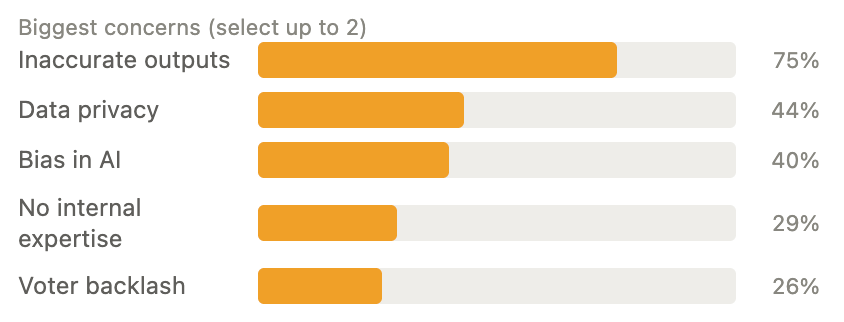
Getting back to AI responses, 75% of campaign professionals named inaccurate or misleading outputs as their biggest concern about using AI. In our Rainey Center voter poll, 62% said false or misleading content is their top concern about AI in politics. Same fear, different seat, and it makes sense that they rhyme, because they’re responding to the same underlying reality.
The third seat at the table belongs to the companies building these tools, and they’re grappling with the same problem. As I covered last week, Anthropic has published a detailed methodology for measuring political even-handedness and has open-sourced the evaluation so others can replicate it. OpenAI announced plans to incorporate authoritative sources on voting logistics. Both have partnered with Democracy Works to direct users to reliable information when they ask civic questions. (Disclaimer: I’m on the Democracy Works board.)
These aren’t companies shrugging at the problem. They’re genuinely trying to figure out where the lines are, including what the responses are when someone asks about candidates, what counts as political neutrality, and when to generate an answer versus route to a primary source.
On June 11th at 1 pm ET, I'm hosting a free, live briefing on AI and the 2026 midterms — pulling from our Rainey Center poll of 1,010 likely voters and our survey of 68 campaign professionals. It's also a preview of what my monthly Briefing Network calls look like. Space is limited.
But here’s what I think is missing from that conversation: we need more transparency from the companies themselves about what they’re learning, what they’re getting wrong, and how they’re making these decisions. The bias conversation — which direction does the model lean? — is part of it, but it’s not the full picture. How are they deciding what sources to surface? How are they handling the gap created when major news organizations block AI scrapers and state-controlled foreign media fills the void? How are they thinking about elections in smaller markets, like the Scottish election, where Demos found AI giving voters misinformation in response to 34% of questions? These decisions are shaping what millions of people see when they ask civic questions, and the current level of public disclosure about how those decisions are made is insufficient.
Disclosure shouldn’t be limited to campaigns. It belongs to the companies, too.
🔒 Disclosure is a framework, not a label
In our voter poll, 57% said disclosure of AI-generated content is very important to them, 78% when you include “somewhat important.” Voters want to know. Among campaign professionals using AI for voter-facing content, only 12% always disclose. Thirty-one percent don’t disclose at all or haven’t decided.
When asked to name their top concerns, only 27% of campaign professionals chose voter backlash — ranking it second-to-last. But when asked directly how concerned they are about voters reacting negatively, 60% say very or somewhat concerned.
The instinct when you hear “campaigns should disclose AI use” is to imagine a label on a piece of content: This ad was created with AI assistance. As I laid out in the AI Transparency Workbook I released for paid subscribers this week, that label tells voters almost nothing about what actually happened. Was it an AI-generated image with no human review? A human-written script edited by AI for length? A message targeted to a specific voter segment using AI? “AI was used” is the equivalent of “computers were involved.”
What works better is a layered framework:
A campaign-level AI use policy on your website. Plain language. Which functions AI touches, what human review looks like, and what you’ve decided not to automate. Something a reporter, a voter, or an opponent could read and understand. This is the accountability layer — it exists regardless of whether any individual piece of content gets labeled.
A tiered standard for voter-facing content. The closer AI gets to a direct voter interaction, the more specific the disclosure needs to be. A chatbot talking to a voter needs to identify itself. An AI-generated image in an ad needs to say so. A human-written email tightened by AI probably doesn’t, but that’s a line campaigns need to draw consciously, not by default.
Everyone focuses on the drafting question — did AI write this? — and misses the five other stages where AI shapes the work. Research, targeting, monitoring, synthesis. That’s where AI is already doing significant work inside campaigns, and where almost no one is building transparency standards yet.
The broader principle: governance before crisis. Building this infrastructure now is dramatically easier than building it under a reporter’s deadline.
⚠️ If your campaign doesn’t have an AI policy, stop and build one
Thirty-three percent of campaign professionals in our survey have no AI policy, and that needs to change.
If your campaign or organization doesn’t have a policy for how staff can use AI — what tools are approved, what data can go into them, what human review is required before anything goes out — build one now. Before something goes wrong, rather than after.
The voter file is the specific place I’d start. 23% of respondents use AI for voter data analysis, and there are safe, secure ways to do that work. But they require using the right tools in the right configurations. Enterprise versions of these platforms don’t train on your inputs. Consumer versions often do. That distinction matters enormously when you’re feeding in personally identifiable information about voters. Know which tools your staff is using, know whether you’re running enterprise or consumer versions, and establish clear rules about what data can go in. A voter file is not the same as a draft press release.
The broader principle: governance before crisis. Building this infrastructure now is dramatically easier than building it under a reporter’s deadline.
🔭 Where this is heading
Two tools launched recently that point at what the next phase looks like.
Run for Something built CampSight to help campaigns understand what AI chatbots are saying about their candidates — and change it. The premise: millions of voters are asking ChatGPT and Google AI about races on their ballot. Most campaigns have no idea what those tools are saying about them. CampSight monitors those outputs daily and tells campaigns how to improve their “GEOScore” — their visibility and accuracy in AI-generated answers.
Proximity launched Smart Messaging Engine this month — continuous social listening across news, social platforms, and community conversations in a district, surfacing emerging sentiment shifts and helping draft responses timed to the moment.
On the operational side, the Higher Ground Labs AI Show and Tell last week illustrated how fast the agentic shift is moving on the progressive side — AI systems that don’t just answer questions but take actions. A canvasser records a voice memo after knocking a door; an agent transcribes it, tags the issues the voter raised, drafts a follow-up text in the candidate’s voice, and stages it in the SMS tool. That’s one workflow being built right now. Lisa Schneegans made a similar point from the Republican perspective this week: the real advantage isn’t louder content, it’s operational intelligence — contactability models, influencer identification, engagement scoring.
This is the shift from AI as a content generator to AI as an intelligence layer. The campaigns that figure out how to use it well, with human review, clear data standards, and honest disclosure, are going to operate at a fundamentally different level. And they’re building that advantage right now, heading into 2028.
One last thing
Both surveys point to the same reality: the concerns are real, the tools aren’t going away, and the infrastructure to navigate both honestly is still being built — by campaigns, by voters trying to make sense of what they’re seeing, and by the companies whose decisions shape all of it. We’re all working it out in real time.
What I’d love to know is how you’re thinking about it. If you work in campaigns or political consulting, do you have an AI use policy? How are you approaching disclosure for voter-facing content? If you’re a voter, what would you actually want to see from a campaign to feel like they were being straight with you about how they’re using AI?
Drop it in the comments. These standards are being written right now, and the more practitioners talk them through openly, the better they’ll be.
PS: Make sure to check out Amanda Elliott’s analysis of this data here.
The Anchor Change campaign AI survey was conducted in May 2026 (n=68). Full data and interactive charts are available at anchorchange.com/campaign-ai-survey. The Rainey Center voter poll surveyed 1,010 likely voters May 15–18, 2026. The AI Transparency Workbook — including a seven-question framework for writing your own policy and a full disclosure template — is available for paid subscribers.
Katie - great conversation between you and Chris earlier - thanks for doing that! I found the partisan split graphic really interesting, as I was reading this morning about a recent survey that tested AI platform values. Which got me wondering almost this exact same thing - if a human with similar values to "Platform A values" doesn't like how Platforms B-Z interact or respond, will they simply ignore B-Z and spend the majority of their time on A and inadvertently just double down on their own values and bias? We've 20+ years of data seeing this play out on social media - algorithms that keep feeding us what we click on. Only now it has a personality too? LI post that got me thinking and their survey results here: https://www.linkedin.com/posts/chrislaw_valuerank-slides-activity-7467285378065092608-Lsml?utm_source=share&utm_medium=member_desktop&rcm=ACoAAABlNyIBdKfYum4h6jo7HftRcieZ5jFxohs
How exactly are the tools getting political fact checking wrong. 90% is a really big number.